AI in Public-Sector Software: How We Use It Safely
Every buyer is asking the same question now.
Not “do you use AI?” Almost every software team does.
The real question is: “Can I trust how you use it?”
This is our answer.
Yes, we use AI
We will not pretend otherwise. AI coding tools are good at a lot of the work that slows a project down.
- First drafts. Boilerplate code, test cases, data migrations.
- Finding problems. A second pair of eyes on a change before a person reviews it.
- Understanding old code. Explaining a legacy system faster than reading it line by line.
- Documentation. Keeping technical notes in step with the code.
Used well, that means your budget goes on the hard problems, not the repetitive ones.
But speed is not the point. A public service has to be right, secure and accessible. So we set clear rules.
Rule one: a person decides
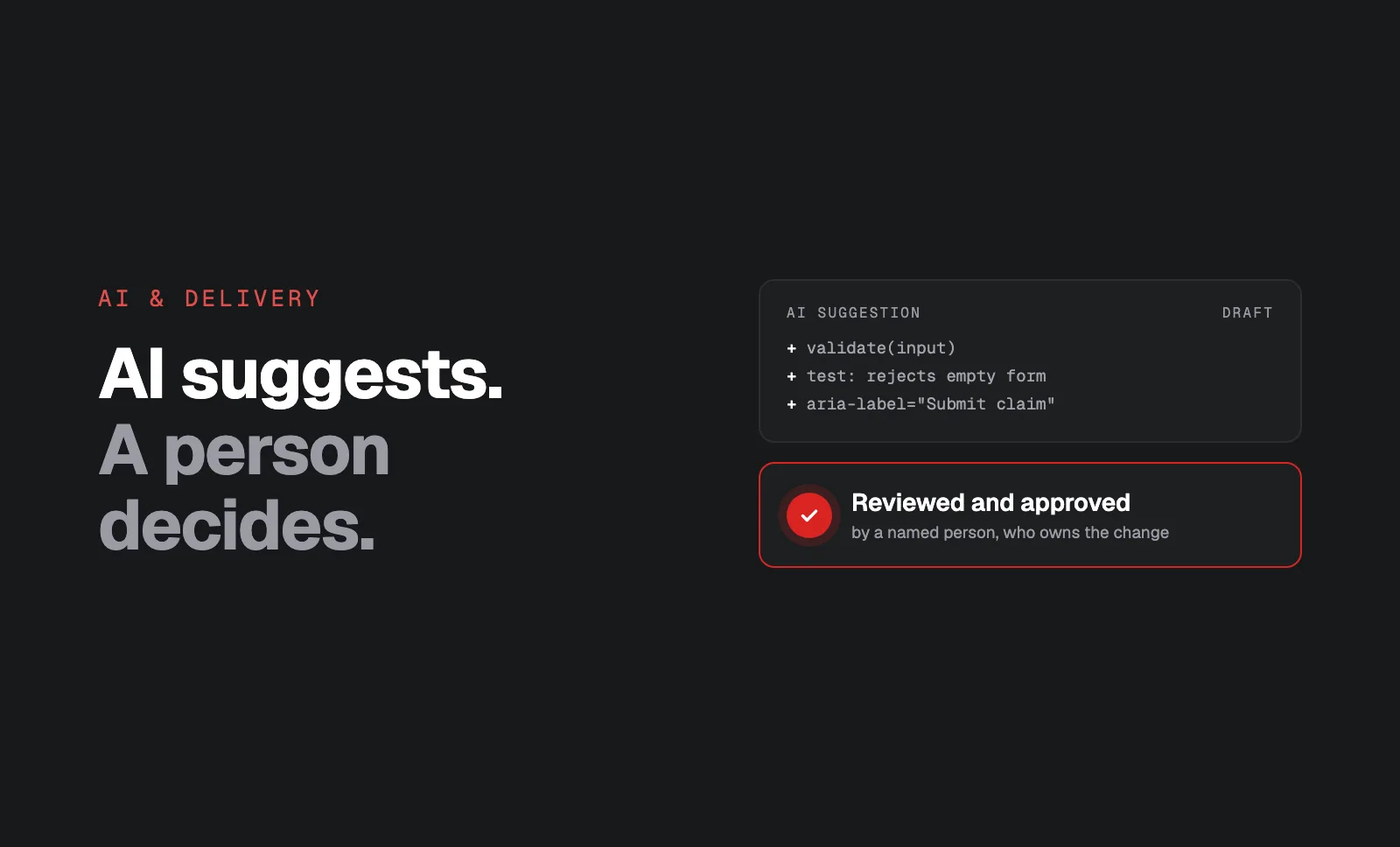
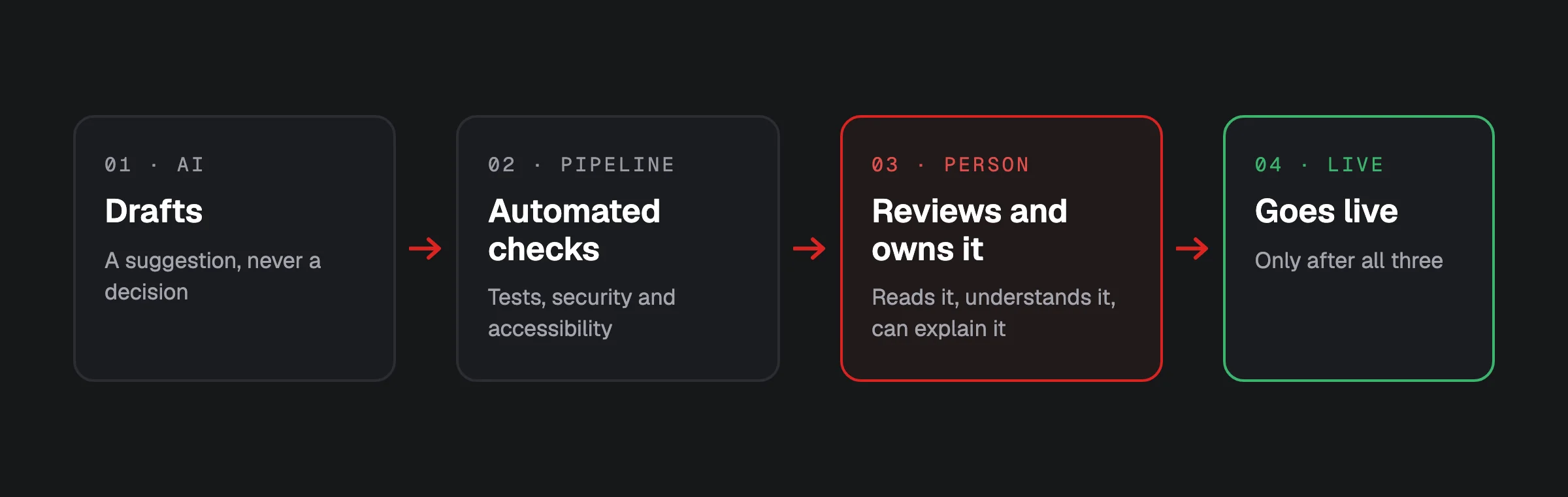
AI suggests. A person decides.
Nothing an AI tool writes goes live on its own. Every change has a named person who is responsible for it. They read it, understand it, and can explain it. If they cannot explain a line, it does not ship.
Every change also passes the same automated tests and checks as code written by hand. The pipeline does not care who, or what, wrote the first draft.
Rule two: your data stays out
Your data is not ours to share, and that includes sharing it with an AI tool.
- No personal data goes into an AI tool.
- No client data, credentials or secrets go into an AI tool.
- Business-grade tools only. We use AI tools on business terms where our inputs are not used to train the provider’s models.
When an AI tool needs an example to work with, it gets made-up test data. Never the real thing.
Rule three: your policy comes first
Many public bodies now have their own rules on AI. The government’s AI Playbook sets out ten principles, including using AI securely and keeping meaningful human control.
We follow your rules on your project. If you want AI tools kept out of your work entirely, we can deliver that way, and we will tell you plainly what it changes.
And if AI becomes part of the service itself, not just how we build it, that is a decision we make with you, in the open, from the start.
What we will not do
- Ship code nobody on the team understands.
- Let an AI tool decide anything about the people who use your service.
- Hide where AI was used, if you ask us.
What this means for you
You get the speed AI brings to the routine work.
You keep the things that matter in a public service: people who understand the code, data that stays where it should, and a team that can answer for every line.
AI writes faster.
People decide what is right.
We keep it that way round.